Featured Car Collectors
Mike & Judy Gaylor
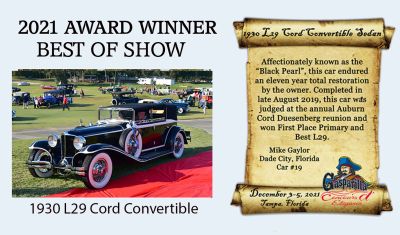
The crown jewel of the Gaylor Collection is their outstanding 1930 L-29 Phaeton Convertible Sedan.
The car is housed in an air-conditioned barn in Dade City, Florida.
Affectionately known as the "Black Pearl " This car has undergone an 11-year owner restoration, which was completed in August 2019. The car was taken to Auburn, Indiana, for the annual Auburn Cord Duesenberg Club reunion, where it received a first-place primary and best L29 award.
Historically, the L29 was the 1st American front wheel drive car mass-produced beginning in 1929. Previous owners have been traced back to the early 1970s, when the car was in Argentina. It is rumored to be the car that won the Concours d'Elegance in France in 1930. A Pebble Beach participant and the 2021 Gasparilla Concours d' Elegance Best in Show.
Featured Car Collectors
Derek and Marcy Hennecke
The Gasparilla Cars in the Park is honored that Derek and Marcy Hennecke have accepted our invitation to be one of the 2026 Featured Car Collectors. Together, they have amassed an exquisite collection of rare vehicles from a variety of eras.
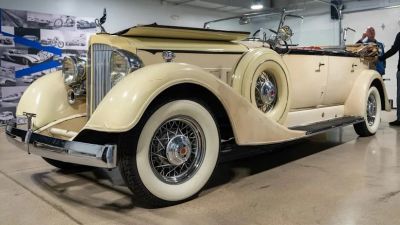
The Hennecke’s will bring the newest addition to their collection: a beautiful 1934 Packard with a wonderful provenance.
In the fall of 1976 the Marquette basketball team put on tuxedos and drove out to the Brooks Stevens museum in Mequon for a team photograph. They posed with a 1934 Packard dual cowl sport phaeton, cream with dark fenders, that Brooks had owned since before the war. Those young men were about to play the 1976–77 season, which ended with Marquette's first NCAA men's basketball championship.
Stevens, who also designed the Oscar Mayer "Wienermobile," died in 1995. His car collection was sold over the next few years, putting the Packard on a long journey. It spent time in New Jersey, then several years in Canada, before landing in sunny Florida with Derek and Marcy Hennecke.
It is an Eleventh Series Packard Super Eight, Model 1104, with the dual cowl Sport Phaeton body identified as style 761. Its vehicle number is 761-25 and its engine number is 753694. The car's history describes its coachwork as Dietrich; the useful distinction for this story is that style 761 was a catalogued Packard offering, rather than a claim that this was a one-off commission.
In 1934 Packard offered the Eight, Super Eight and Twelve. The Super Eight occupied the upper eight-cylinder tier, between the Eight and the flagship Twelve. Packard's contemporary advertising gave their respective outputs as 120, 145 and 160 horsepower. The Super Eight was therefore much closer to the Twelve in advertised horsepower than the names alone might suggest, although the Twelve remained the top model.
The 1104 used the nominal 142-inch wheelbase, between the Super Eight's 135-inch 1103 and 147-inch 1105. The Packard Club's reference data lists the four-passenger 761 Sport Phaeton at $3,350 and 4,740 pounds shipping weight, against $3,090 for the ordinary 751 Phaeton. These are period catalogue figures, not a surviving invoice for this car. This was still the Packard range before the One Twenty arrived in 1935.
The second cowl and rear windscreen give the Sport Phaeton its identity. The rear passengers have a windscreen of their own, and the extra cowl breaks the long passenger compartment into two distinct spaces. It is a particularly appealing arrangement for an open touring car: the rear seat becomes a proper part of the design, rather than simply a bench behind the driver. With its long hood and separate fenders, the car has the proportions that make an open Packard of this period so recognizable.
The engine is the 384-cubic-inch L-head straight eight, rated at 145 horsepower, with a nine-bearing crankshaft. Behind it is a three-speed synchromesh gearbox. It has vacuum-assisted mechanical brakes on all four wheels, Bijur chassis lubrication and wire wheels. Those details are worth retaining in the story because this has continued to be a touring car.